What happens in the room.
Every session is one-to-one with me. No assistants, no hand-offs. What follows is an honest account of what each treatment involves and why it's part of the work I do.
Your first appointment runs for sixty minutes and it begins with a conversation, not a checklist. I want to understand what happened, how long things have been difficult, what your hands need to do in daily life, and what a good outcome actually looks like for you. That context shapes everything that follows.
From there I move into a structured clinical evaluation: range of motion, grip and pinch strength, sensation, joint stability and the integrity of tendons and ligaments where relevant. Where you've had surgery or imaging, I'll review the operative notes and any scan reports alongside the physical findings. The assessment is designed to give me the full picture, not just the presenting complaint.
By the time you leave you'll have a clear understanding of what's going on, why things feel the way they do, and a realistic plan for what comes next. I'll always explain my clinical reasoning in plain language. There's no rushed five-minute handover at the end; time to ask questions is built in from the start.
Thermoplastic is a low-temperature material that becomes mouldable when warmed in water and sets firmly as it cools against the skin. This allows each splint to be individually formed to your anatomy, in the exact position, angle and level of support required for your injury or post-operative recovery.
Unlike off-the-shelf braces, a custom thermoplastic splint is designed specifically for your hand. This precision allows optimal positioning of tissues, which can influence tendon glide, fracture alignment and joint irritation during healing.
Each splint is designed to protect the injured structures while allowing as much movement as is safely possible in the surrounding joints. This balance is a key part of effective hand therapy.
Splints are lightweight, low profile and can usually be worn under clothing. Depending on your condition, they may be worn full time initially and then gradually reduced, or used selectively for rest or activity. I review and adjust splints at each appointment as your recovery progresses.
There is a separate charge for splinting materials, which is not included in the appointment fee and is not typically covered by private medical insurance. This will always be explained clearly before a splint is made.
A rehabilitation programme is not a standard exercise sheet. It is a structured, evolving plan built around the specific structures affected, the phase of your recovery, and what you need your hand to do. I develop it based on my assessment findings and adapt it at every appointment in response to how things are progressing.
Progressing at the right pace is one of the most misunderstood aspects of hand therapy. Move too aggressively and you provoke inflammation, disrupt healing tissue, or cause compensatory strain elsewhere. Move too cautiously and you lose range of motion, allow adhesions to form, and miss the optimal window for tendon gliding or joint rehabilitation. Getting the pace right is a clinical decision, not a fixed timeline; it depends on what the tissue is telling us at each stage.
The home exercise element is integral, not optional. I'll teach each exercise with sufficient detail that you can perform it safely and accurately between appointments. The work in the clinic amplifies what you do at home; they're part of the same programme. Most patients are seen weekly or fortnightly; the gap between sessions is not passive time.
Post-operative wound care begins as soon as it is safe to do so, often within the first week or two following surgery. In this early phase, the focus is on supporting clean healing, monitoring for signs of infection or delayed recovery, and ensuring dressings are appropriate for the stage of the wound. I liaise with your surgical team where needed.
As the wound matures, attention shifts to scar management. Scar tissue is naturally dense and inelastic, and when it forms across a joint or over a tendon it can restrict movement. Adhesions, where scar tissue binds to underlying structures, are a common reason for persistent stiffness following otherwise successful surgery.
Scar mobilisation at the appropriate stage can help reduce adhesion formation and support more functional tissue remodelling. This process is most effective while the scar is still maturing, typically within the first six to eighteen months.
Treatment may include manual scar massage, silicone sheeting and compression where indicated. I will also teach you self-management techniques to use at home between appointments, as regular short periods of treatment are often more effective than infrequent longer sessions.
Joint mobilisation is a hands-on technique applied directly to specific joints, including the radiocarpal wrist, the interphalangeal joints or the carpometacarpal joint at the base of the thumb, depending on restriction. I use graded oscillations and sustained techniques to improve joint mechanics, reduce pain and restore range of motion. Treatment requires careful clinical judgement regarding direction, force and timing within the healing process.
Soft tissue mobilisation is used to address restriction within muscles, fascia and tendons, particularly following injury, surgery or periods of immobilisation. It can help reduce stiffness, improve tissue extensibility and support more efficient movement patterns in the hand and forearm. When applied appropriately, it is well tolerated and often followed by an immediate improvement in ease of movement.
These hands-on techniques are always integrated with exercise-based rehabilitation to ensure improvements in mobility are maintained and translated into functional use of the hand in daily life.
For most patients, the goal is to return to work, daily activities or sport. For a smaller group, including musicians, surgeons, craftspeople and professional athletes, the demands are more specific, more technical and the consequences of suboptimal rehabilitation are greater. This is an area of practice I have extensive experience in.
Musicians often present with conditions ranging from acute tendon injuries and overuse syndromes to postural strain and focal overload patterns. Technique is frequently central to both the development of symptoms and the rehabilitation process. Understanding how an instrument is held and played, whether that is bowing technique in violinists, octave control in pianists or wrist positioning in guitarists, allows rehabilitation to be tailored in a way that is meaningful and transferable to performance.
Surgeons, dentists and other precision-based professionals face similar challenges. The demands placed on fine motor control, pinch strength and endurance are significantly higher than in the general population, and rehabilitation must reflect this.
Return-to-activity programmes are therefore built around individual occupational and performance requirements rather than generic timelines. The aim is not simply recovery, but safe and confident return to the specific tasks that matter most.
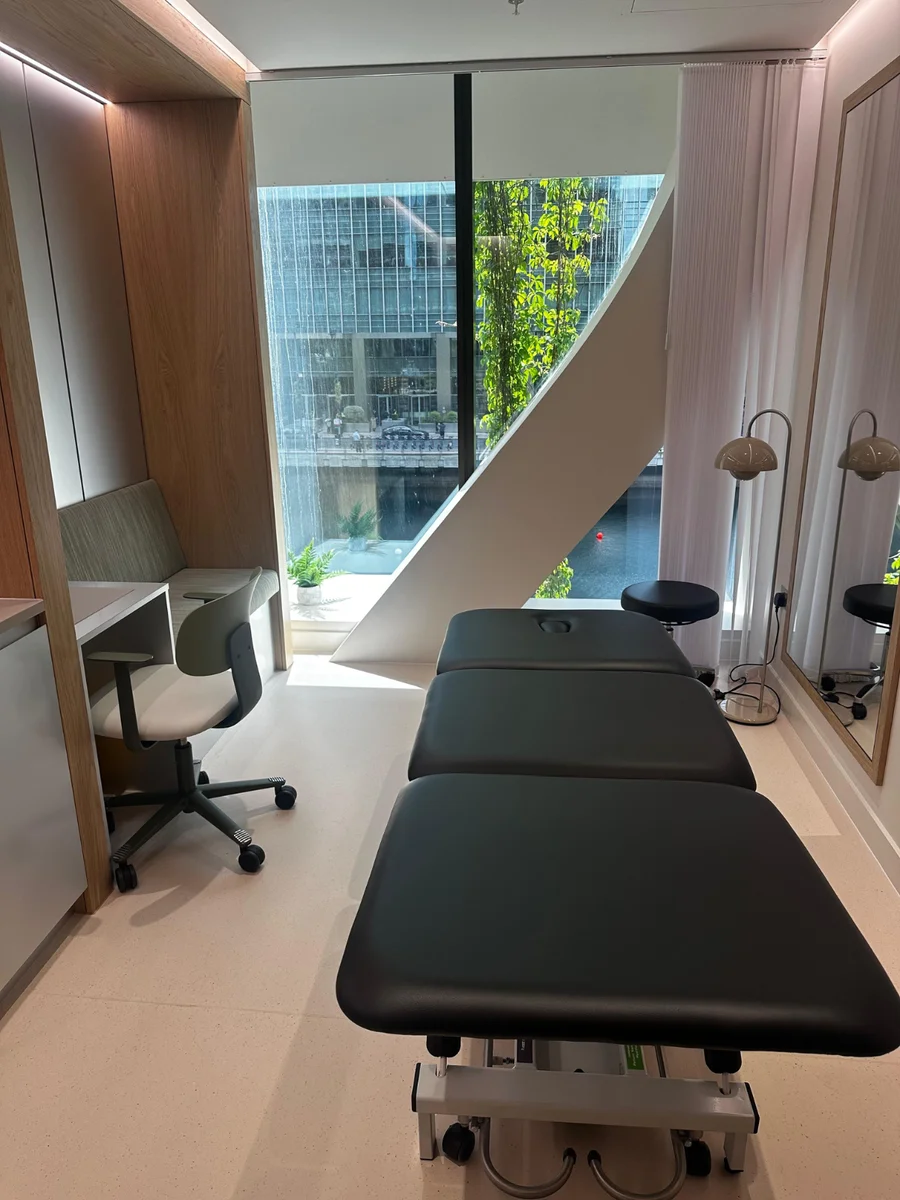
A dedicated space for specialist care.
All three clinic locations are purpose-built for physiotherapy and hand therapy. Private treatment rooms, specialist equipment, and a clinical environment designed around patient recovery.
Appointments are one-to-one with Jen throughout — no rotations, no handovers.
Ready to book an appointment?
The first step is a conversation. Get in touch and I'll make sure you're booked into the right appointment for where you are right now.